
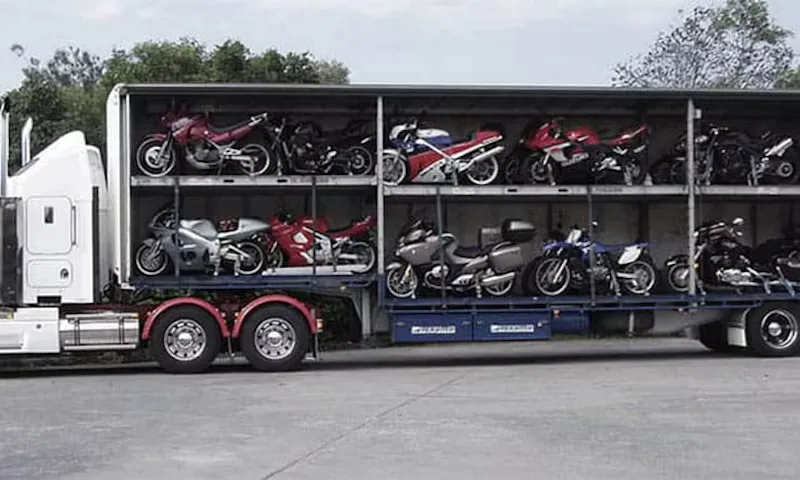
Brazil is the largest motorcycle market in Latin America, and importing motorcycle parts from China to Brazil is where the real margin is — but also where the most expensive surprises hide. One wrong digit in the tariff code, one missing registration, and a container that should clear in days sits in Santos accruing storage fees while your customer waits.
This guide is written from the supplier side of the table. We ship motorcycle LED lighting and accessories from our factory to Brazilian importers, distributors and marketplace sellers, so the checklist below is the one we use when a Brazilian buyer asks: “what do you need from us to clear customs?”
Note for 2026. Brazil’s tax system is mid-reform: CBS and IBS appear on invoices from 2026 as pilot taxes, and the full transition (CBS replacing PIS/COFINS, IPI eliminated for most products, ICMS and ISS phased out) runs to 2033. Figures below reflect the rules in force for imports in 2026 — confirm live rates for your exact NCM with your despachante aduaneiro before placing a purchase order.
Why Brazil, and why now
The demand side justifies the paperwork. According to Abraciclo (the Brazilian motorcycle manufacturers’ association), 2025 set records and 2026 keeps growing:
| Indicator | 2025 actual | 2026 projection |
|---|---|---|
| Production (Manaus assembly plants) | 1,980,538 units (+13.3% YoY) | Over 2,000,000 units |
| Retail registrations (new plates) | 2,197,851 (+17.1%, all-time record) | 2,300,000 (+4.6%) |
| Exports | 43,117 (+39.1%) | ~45,000 |
Every one of those millions of bikes is a future parts customer — lamps, levers, racks, locks and wear items. First-half 2026 production was already up 6.3% year on year. And the aftermarket supply gap is real: Brazil imported roughly $1.8 billion under HS 8714.10 (motorcycle parts) in 2024, with China the top supplier at $628.6 million — a 34.7% share of the category, ahead of India (15.6%) and Thailand (10.3%). The lane is proven; the question is execution.
Step 1: Get licensed before you order — RADAR and Siscomex
No CNPJ, no RADAR, no import. Brazil does not let a foreign company clear commercial goods directly:
| Requirement | What it is | Where you get it |
|---|---|---|
| CNPJ | Brazilian corporate taxpayer number — the legal entity that imports | Receita Federal, after incorporating (typically a Ltda.) |
| RADAR habilitation | The importer registration that unlocks Siscomex, granted to a CNPJ | Portal Único Siscomex, “Habilita” module, via Receita Federal |
| Legal representative + digital certificate | e-CNPJ certificate held by a representative in Brazil | Brazilian certifying authority |
| Siscomex access | The single foreign-trade window where every import declaration (DI) is filed | Granted with RADAR |
RADAR comes in three modalities. Express is the fast track for qualifying small importers. Limitada caps the value you can import per six-month window until you demonstrate financial capacity. Ilimitada has no ceiling. Most new importers start Limited and graduate.
If setting up a Brazilian entity is not worth it yet, the practical alternative is an Importer of Record — a Brazilian trading company that already holds CNPJ and RADAR and imports the goods in its own name for a fee. There is no third door: the customs system will not register a declaration against a foreign entity with no CNPJ and no RADAR.
Step 2: Classify every SKU under its NCM code
“Motorcycle parts” is not a tariff line. Brazil uses the NCM (Nomenclatura Comum do Mercosul — the Mercosur Common Nomenclature) and its TEC (Tarifa Externa Comum, the Common External Tariff). The NCM code drives the II rate, the IPI rate, and your exposure to licensing. Anchor codes for this category:
| Product | NCM / HS heading | Notes for importers |
|---|---|---|
| Mechanical moto parts (levers, racks, pedals, guards) | 8714.10.00 | The main “parts and accessories of motorcycles” line |
| Vehicle lighting and signalling (headlamps, bulbs, indicators) | 8512 | Electrical chapter — verify the exact NCM with your broker |
| Ignition, charging, electrical control parts | 8511 / 8536 | Separate rates from chapter 87 |
| Tyres and inner tubes | 4011 | A classic misclassification against 8714 |
| Mirrors, plastics, small hardware | 7009 / 3926 / 7318 | Each carries its own rate |
The anchor line, NCM 8714.10.00 “De motocicletas (incluindo os ciclomotores)”, carried 14.4% import duty (II) and 12% IPI as of the May 2026 tariff update. A misclassification does not just risk a fine — it changes your landed cost by double digits after the cascade, discovered when the goods are already on the water.
Step 3: Budget the seven-tax cascade — Brazil’s real import price
This is the part generic freight guides underestimate. Seven charges stack on each other, each calculated on a base that includes the previous ones:
| # | Tax | Base | Typical level (verify per NCM) |
|---|---|---|---|
| 1 | II — Imposto de Importação | CIF value | 0–35% by NCM; most industrial goods 14–20%; 8714.10.00 = 14.4% |
| 2 | IPI — tax on industrialized products | CIF + II | 0–300% in the TIPI table; most goods 0–15%; 8714.10.00 = 12% |
| 3 | PIS | CIF (non-cumulative) | 2.1% (or 1.65% cumulative) |
| 4 | COFINS | CIF (non-cumulative) | 9.65% (or 7.6% cumulative); +1% on some Annex I goods |
| 5 | ICMS — state VAT | CIF + II + IPI + PIS + COFINS + AFRMM + Siscomex fee, grossed up “por dentro” | 17–22% by state (São Paulo 18%, Rio de Janeiro 20%, Santa Catarina 17%) |
| 6 | AFRMM | 8% of the international sea freight | 8% of ocean freight |
| 7 | Siscomex fee | Fixed per import declaration (DI) | Small fixed amount |
Two structural facts to price in from day one. First, ICMS is calculated “por dentro” — the tax is included in its own base, so the effective rate is higher than the headline number. Second, once you resell across state lines, imported goods with more than 40% foreign content move at a flat 4% interstate ICMS (Resolução do Senado 13/2012) — which is why distributors warehouse in one state and serve the country from there.
A worked landed-cost example
The numbers below are illustrative — swap in your broker’s rates — but the structure is real. Example: 2,000 LED headlight assemblies, NCM 8714.10.00, FOB USD 8.50/unit, ocean freight USD 1,300, insurance USD 100, cleared in São Paulo (ICMS 18%), importer on the non-cumulative PIS/COFINS regime:
| Line | Value (USD) | Basis |
|---|---|---|
| FOB goods (2,000 × 8.50) | 17,000.00 | Invoice |
| Ocean freight + insurance | 1,400.00 | B/L + policy |
| CIF (customs value) | 18,400.00 | |
| II — 14.4% | 2,649.60 | CIF |
| IPI — 12% | 2,525.95 | CIF + II |
| PIS/COFINS — 11.75% | 2,162.00 | CIF |
| AFRMM — 8% of freight | 104.00 | Freight |
| Siscomex fee (illustrative) | 40.00 | Fixed |
| ICMS — 18% “por dentro” | 5,681.32 | All above ÷ (1 − 0.18) |
| Landed cost before local handling | 31,562.87 | +71.5% over CIF — 15.78/unit |
FOB to landed, the price of each headlight more or less doubles. That is not an error — Brazilian imports genuinely carry one of the heaviest cascades in the world, and it is exactly why buyers who price only “product + freight” lose their margin in the first year.
From our own shipping floor: the two Brazil holds we see most are self-inflicted at the PO stage. First, invoices that describe “motorcycle parts” without the NCM — the DI declaration must match the invoice line by line, and a vague description invites a channel-red inspection that costs 10–20 days. Second, cartons whose gross weight on the packing list does not match the scales at the CFS — we now weigh every export carton twice and stamp the list at the factory, because a 2% weight mismatch in Santos is a demurrage bill, not a conversation.
Step 4: Choose the shipping mode against your sell-through
| Mode | Best for | China → Brazil reality |
|---|---|---|
| LCL sea freight | 2–10 CBM, mixed SKUs, first trial orders | ~35–45 days port-to-port to Santos or Paranaguá, plus clearance |
| FCL 20’/40’ | Full ranges, repeat orders | Same ocean leg; lowest cost per unit |
| Air freight | Restocks, promotions, high-value/low-volume | Days, several times the sea cost per kg |
| Express courier | Samples only | Fast, but impractical for commercial volume |
Book inspection buffer into your calendar. China-origin shipments are selected for physical inspection more often than average, and a red-channel exam adds days plus terminal charges on top of the cascade above. If your sales are seasonal — Carnival accessories, year-end gifting — that buffer is not optional.
Step 5: Lock the compliance and resale details early
Three decisions belong in the purchase order, not after the ship sails:
- Portuguese retail information. Consumer-facing packs sold in Brazil carry Portuguese labelling; fixing it at the factory costs cents per unit, re-labelling in a fiscal warehouse costs reais.
- Interstate resale plan. With the 4% interstate ICMS rule for high-import-content goods, where you clear and where you warehouse are a tax decision, not just a logistics one.
- The reform clock. From 2026, CBS (0.9%) and IBS (0.1%) appear on invoices as pilot taxes with no real collection impact. From 2027, CBS replaces PIS/COFINS and IPI is eliminated for most products; the full CBS/IBS/Selective-Tax regime consolidates at ~28% by 2033. A two- or three-year supply contract should anticipate the switch.
What to import first for the Brazilian market
Match the mix to the fleet: Brazil’s market is scooter- and commuter-heavy, with a huge delivery segment.
| Buyer profile | Recommended opening mix | Why it clears well |
|---|---|---|
| Distributor / import agent | LED headlight bulbs and assemblies, universal levers, mirrors, turn signals | NCM 8714/8512 anchor codes, proven 34.7% China supply share, fast rotation |
| Marketplace seller (Mercado Livre class) | Plug-and-play LED bulbs, small lighting accessories, USB chargers | Low unit weight, high margin after the cascade, compact parcels |
| Delivery-fleet supplier | Racks, top cases, locks, wear items | B2B repeat orders; pair with the CONTRAN-compliant accessories your fleet customers ask for |
Our volume categories for Brazilian buyers sit in motorcycle LED lighting — start with LED headlight bulbs like the H4 LED headlight bulb and the 7-inch projector headlight for Bajaj Boxer — plus luggage and commuting lines such as the 30L top case and the NMAX 155 luggage rack, and universal fitment parts in brake levers and luggage storage.
The document set your supplier must deliver
Write this into the PO — it is what we prepare on every Brazil-bound shipment:
- Commercial invoice with itemised descriptions, quantities, unit values, the agreed NCM per line, Incoterms and your CNPJ — precise enough that the DI matches line by line.
- Packing list by carton: net/gross weight and dimensions that match the physical cartons.
- Bill of lading with a consignee matching the RADAR holder.
- Certificates and test reports for electrical items: CE, RoHS, IP rating evidence.
- Origin declaration — China has no trade agreement with Brazil, so no preference applies, but the declaration belongs in the file anyway.
Frequently asked questions
How much tax do I pay to import motorcycle parts into Brazil?
There is no single rate — the cascade decides. For NCM 8714.10.00 the federal layer is 14.4% II plus 12% IPI, then PIS/COFINS at 11.75% (non-cumulative) and state ICMS at 17–22% calculated “por dentro”, plus AFRMM (8% of ocean freight) and the Siscomex fee. In our illustrative worked example the total uplift over CIF was roughly 71%. Verify your exact NCM and state with a despachante aduaneiro before committing — this is guidance, not tax advice.
Can I import without a Brazilian company?
Not directly: every commercial import needs a CNPJ with RADAR habilitation. The standard workaround is an Importer of Record — a Brazilian trading company with its own RADAR that clears the goods in its name and resells or consigns them to you.
What NCM code covers motorcycle parts?
The anchor line is NCM 8714.10.00 — “parts and accessories of motorcycles (including mopeds)” — currently 14.4% II and 12% IPI. Electrical items such as headlamps and indicators fall under chapter 8512 instead, with their own rates, so classify SKU by SKU rather than by carton.
How long does sea freight from China to Brazil take?
Plan on roughly 35–45 days port-to-port to Santos or Paranaguá, then add booking, factory pickup, customs clearance and inland delivery. Most first-time importers underestimate the door-to-door window by two to three weeks; add more if your shipment is selected for physical inspection.
Does Brazil’s tax reform change import costs in 2026?
Not materially in 2026 — the CBS (0.9%) and IBS (0.1%) pilot rates appear on invoices without real collection. The structural change starts in 2027 (CBS replacing PIS/COFINS, IPI dropped for most products) and completes by 2033, when only CBS + IBS + a Selective Tax remain at a consolidated ~28%.
Source from a factory that prepares your customs file
MaxorPro is a factory-direct supplier of motorcycle LED lighting, modification parts and accessories to importers across Latin America. We ship to Brazilian buyers with the document set above prepared for your despachante — NCM-classified invoices, weighed and stamped packing lists, certifications and test reports — before the container leaves, not after a hold.
If you are also building routes elsewhere in the region, our China-to-Mexico customs guide covers the fracción arancelaria, Padrón and NOM side, and the LED headlight selection guide for the Brazilian market helps you pick the SKUs that clear and sell. Send your product list and target state through the contact form and we will confirm MOQ, lead time and the documents we issue with each shipment.
Official and reference sources
- Abraciclo — 2026 production projection press release
- UOL/Estadão — H1 2026 production +6.3% (Abraciclo)
- Import to Brazil — NCM 8714.10.00 duty rates and 8714.10 trade data
- Import to Brazil — the seven import taxes and the 2026–2033 reform
- Heyship — II, IPI, ICMS, PIS/COFINS explained (PT)
- U.S. International Trade Administration — Brazil import tariffs
- Brazil Tax Brief — RADAR and Siscomex habilitation
- MERCOSUR — Nomenclatura Común (NCM) y Arancel Externo Común (AEC)
This article is commercial guidance, not legal or tax advice. Duty rates, registrations and reform timelines change; always confirm your exact NCM with a licensed customs broker before shipping.