
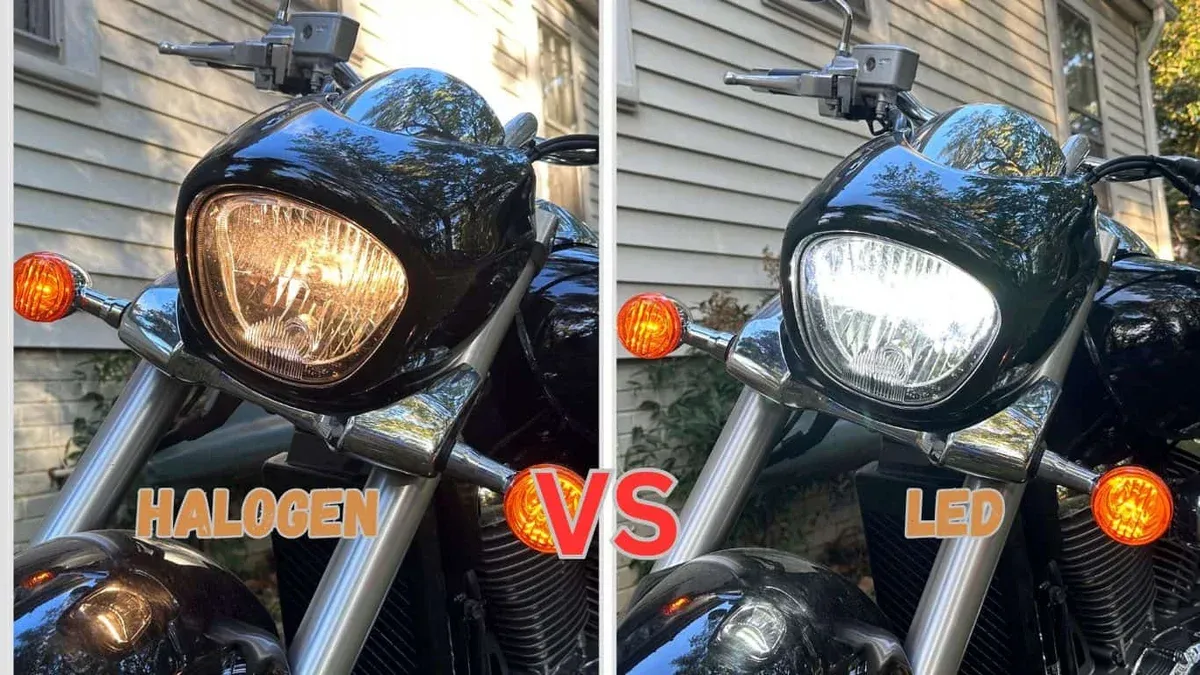
The LED vs halogen motorcycle headlight decision looks simple from a catalogue page — LED is brighter and modern, halogen is cheap and familiar — and it becomes expensive when a buyer in São Paulo gets a traffic ticket, or when a delivery fleet burns out its third bulb of the year on a bike whose stator was never sized for the load. The differences that matter are measurable: lumens, watts drawn, hours of life, and the traffic law that applies in each market.
This comparison is built from published spec data and regulator texts rather than marketing copy — every number below is traceable.
LED vs halogen by the numbers
Strip the marketing away and the two technologies differ on five measurable axes. The ranges below are typical manufacturer ratings for headlight bulbs, not a single product:
| Specification | Halogen bulb | LED bulb | Source |
|---|---|---|---|
| Power draw | 55–100 W | 30–90 W | NAOEVO spec comparison |
| Light output | 800–1,200 lm | 3,600–10,000 lm | NAOEVO spec comparison |
| Energy-to-light efficiency | ~20% of power becomes light | ~80% of power becomes light | NAOEVO spec comparison |
| Color temperature | 3,000–4,300 K (warm white); 2,700–3,200 K in OEM listings | 4,000–6,500 K (cool white) | NAOEVO; Capital.es |
| Warm-up to full brightness | ~1 s (filament must heat) | ~0.1 s (effectively instant) | NAOEVO |
| Typical lifespan | 500–1,000 hours | 15,000–25,000+ hours | KIA; Capital.es |
The efficiency row drives everything else: a halogen converts roughly four-fifths of the energy it draws into heat radiated around the headlamp shell, while an LED converts most of it into light and pushes the residual heat into a small heatsink that must be engineered, not ignored.
For an internal benchmark, the halogen assembly in our own catalogue — the Honda Navi headlight assembly — is rated 35 W, 900 lm and 3,500 K. Our M3 H4 LED is rated 4,500 lm at the same socket: five times the light for less power — exactly the trade your customers ask about at the counter.
What the wattage difference means on a small-bike electrical system
This is the axis almost no comparison article covers, and for Latin America it is the decisive one. The region’s fleet is dominated by 110–160cc commuters and underbones — CG 125/160, Biz, Wave, Crypton, Boxer class — many running small AC magnetos and minimal wiring. Every watt the headlamp wastes is a watt the charging system cannot send to the battery.
| Headlamp | Rated power | Current at 12 V (W ÷ V) | Load on a 90–130 W commuter charging system |
|---|---|---|---|
| Halogen H4 (55/60 W class) | 55–60 W | ~4.6–5.0 A | 40–60% of total capacity just for the headlamp |
| Halogen sealed beam (35 W class, e.g. our Navi assembly) | 35 W | ~2.9 A | What most 110cc bikes were designed around |
| COB LED drop-in (our H4 3-side bulb, 18 W + 9 W) | 18–27 W | 850 mA–1.1 A per spec sheet | Leaves real headroom for phones, GPS and auxiliary lights |
| Mid-power LED (our M3, 45 W) | 45 W | ~3.75 A | Comparable to a small halogen, ~4–5× the lumens |
| High-output LED (our M2PRO, 80 W) | 80 W | ~6.7 A | For 250cc+ bikes or rewired fleets; check stator capacity first |
Two practical rules follow. First, on an AC-stator underbone the cheapest DC-only LED bulb flickers at idle or blows its driver — which is why our bulb line is rated AC/DC 8–80 V, and why the H4 installation guide starts by identifying the bike’s electrical system. Second, the right upgrade order is fitment, connector type, beam pattern, then price — a bulb that fits but blinds oncoming traffic is a warranty problem, not a sale.
Color temperature, glare and the weather caveat
Color temperature is where the two technologies feel most different, and where each has a genuine weakness:
| Property | Halogen | LED |
|---|---|---|
| Color temperature | 2,700–4,300 K, warm yellow-white | 4,000–6,500 K, daylight white |
| Daytime conspicuity | Yellow blends into sunlight and street lighting | White-blue stands out against traffic and buildings |
| Fog, rain and dust | Warmer light scatters less; Motonline notes halogen’s broader, gentler spread in neblina, chuva e poeira | Cooler light scatters more in suspended droplets; sharp cutoff helps when optics are designed for LED |
| Oncoming glare | Low | High — when an LED is dropped into a reflector designed for a filament |
The glare row is the one your customers feel socially. The industry consensus — echoed by Dennis Kirk and Eagle Lights — is that glare comes from poor optics, not LED brightness itself: a filament sits at the focal point of a halogen reflector, and an LED chip with different geometry does not, scattering light upward into oncoming eyes. A projector-style LED or a full assembly with engineered cutoffs fixes this; a cheap drop-in without optical matching creates the “blinding LED” complaints that get retrofits regulated out of a market. Our M2PRO dual-projector bulb exists for buyers who want drop-in convenience without that scatter.
Lifespan and the real cost per year
The sticker price flatters halogen. The hours-of-life figure does not:
| Metric | Halogen | LED | Source |
|---|---|---|---|
| Rated lifespan | 500–1,000 h | 15,000–25,000+ h | KIA; Capital.es |
| Bulbs burned per 15,000 lamp-hours | 15–30 | 1 | Derived from the row above |
| Replacement labour | Per bulb; frequent on working bikes | Essentially zero for the bike’s life | — |
| Failure mode | Filament breaks from vibration and heat cycles | Driver or fan failure on cheap units; slow lumen depreciation on quality units | — |
Worked example, as an illustration: a delivery rider running roughly 600 night-hours a year consumes a halogen bulb every 12–24 months, while even the conservative 15,000-hour LED figure covers more than two decades of that duty — longer than the bike itself. For a fleet buyer the maths is not “LED costs more”; it is “halogen costs more, repeatedly, in parts and workshop time.” That is why Brazilian manufacturers now sell the same model — Honda’s CG 160 among them, per Motonline — in both halogen and LED versions from the factory.
From our own pre-shipment bench: the failure we catch most on LED drop-ins is not the diode — it is the driver. On AC-stator underbones we run every bulb at idle voltage before packing, because a driver sized for clean DC flickers, overheats and dies within weeks on a Wave or CG that feeds the headlamp raw AC. The second check is a wall-pattern photograph at 10 metres: if the cutoff is not sharp and level, the lot does not ship, because that is the unit that blinds oncoming drivers and gets the retrofit category banned in a market.
Drop-in bulb or full LED assembly?
Once a buyer accepts LED, the second decision is mechanical. Both answers are right for different customers:
| LED drop-in bulb | Full LED headlight assembly | |
|---|---|---|
| What it is | LED source in the original halogen socket | Complete lamp: housing, projector/reflector, LED, heatsink |
| Optics | Limited by the original reflector geometry | Engineered for the LED source; clean cutoff |
| Installation | Minutes, plug-and-play | More involved; sometimes bracket or wiring changes |
| Unit cost | Low | Higher |
| Beam quality | Varies enormously by bulb quality | Consistent by design |
| Best for | Fleet retrofits, price-led retail, mixed sockets | Premium retail, new-model replacement, riders with night mileage |
For distributors the two SKUs serve different shelves. Drop-ins move in volume to workshops and fleet retrofits — our H4 3-side COB, the M3 and the M2PRO cover the common sockets, and the MATE series spans H4/HS1/H6/BA20D/P15D from 20 W to 120 W for markets where underbone sockets outnumber H4. Assemblies move on fitment: the WY125 projector assembly answers the WY125 channel, and 5.75-inch and 7-inch round assemblies cover cruiser and Bajaj Boxer classes — all inside motorcycle LED lighting and its LED headlight bulbs segment, where the H4 COB drop-in is the volume entry point.
For the drop-in decision specifically, these four cover the main buyer profiles — budget COB, mid-power fan-cooled, projector-optics and multi-socket wholesale:
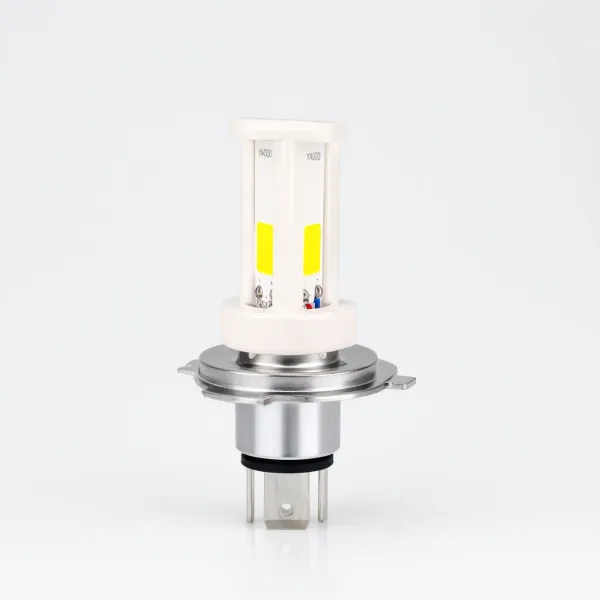
- Power:
- 18W + 9W (13W / 10W operating)
- Lumen:
- 1500 lm (low) + 1200 lm (high)
- Voltage:
- AC/DC 8–80V
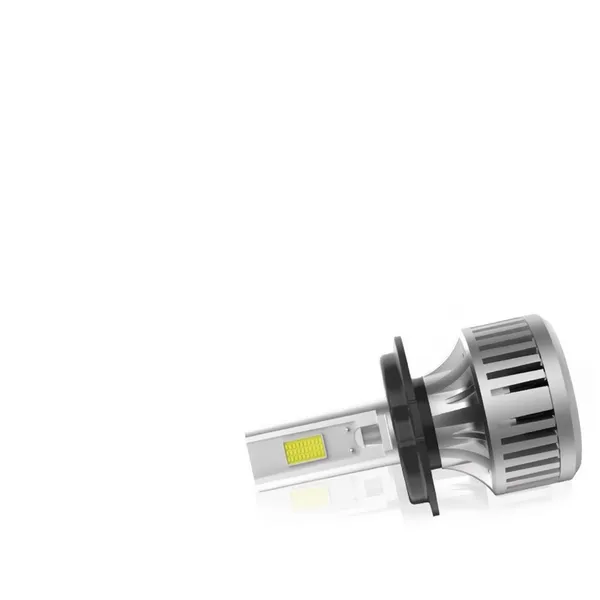
- Dimensions:
- 74 mm x 39 mm
- Function:
- High / low beam + flash
- Power:
- 45 W
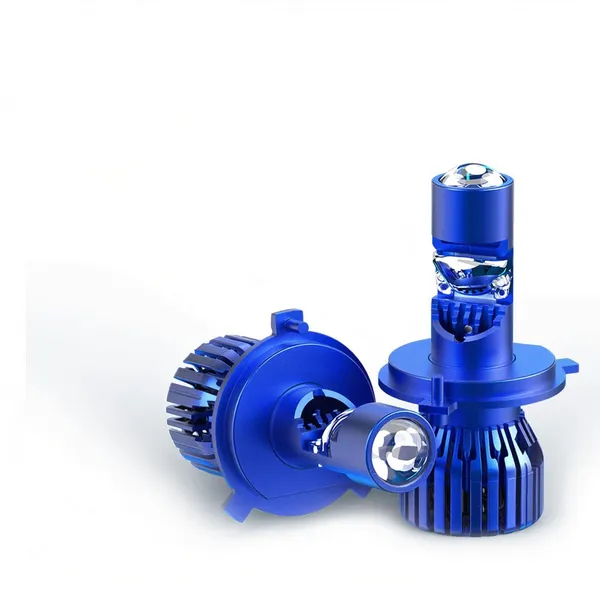
- Power:
- 80 W
- Lumen:
- 10,000 lm
- Input Voltage:
- AC/DC 8-100 V
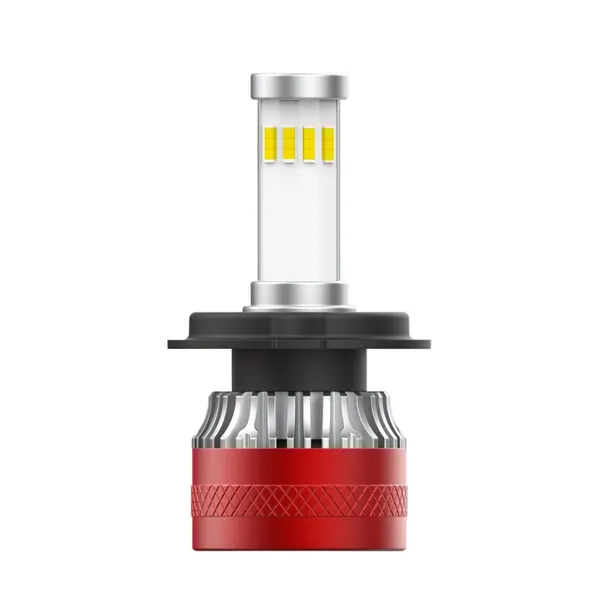
- Material:
- Aviation aluminum with fan cooling
- Power:
- 20W / 30W / 45W / 60W / 70W / 80W / 120W
- Lumen:
- 3000–16000 lm
The regulation layer: Europe’s bulb ban and Brazil’s LED fine
Two regulatory facts are routinely misreported, and both shape what you should import.
Europe banned halogen bulbs in 2018 — but not headlamp units. Under Regulations (EU) 244/2009 and 1194/2012, the EU prohibited manufacturing and selling non-directional halogen bulbs for general lighting from 1 September 2018. As Motorpasión correctly flagged at the time, this does not outlaw vehicle headlamps: the ban targets replaceable bulbs, not sealed lighting units, and vehicle-type halogen lamps were largely outside its scope. What it did do is accelerate OEM migration: every major manufacturer now designs around LED, and halogen is becoming a repair-market niche rather than a factory fitment.
Brazil fines unhomologated LED retrofits. The rule your customers hit in practice is Brazilian. Under Article 230, VII of the Código de Trânsito Brasileiro, running mandatory equipment outside CONTRAN’s standards is a grave infraction — which, per Doutor Multas’ summary, means a R$ 195.23 fine, 5 CNH points and vehicle retention until regularization when a halogen headlamp is replaced with LED without technical authorization. CONTRAN Resolution 882/2021 reinforces that vehicle lighting must match current homologation standards; factory-fitted LED is homologated by the manufacturer and passes SENATRAN testing, while a workshop drop-in usually is not. Our companion guide on the Brazil LED headlight market goes deeper on what this means for assortment planning.
| Market | Rule in force | What it means for your stock |
|---|---|---|
| European Union | Bulb manufacturing/sale ban since Sept 2018 (Regs. 244/2009, 1194/2012); headlamp units not banned | Halogen is a declining repair niche; LED-first assortments |
| Brazil | CTB art. 230 VII + CONTRAN Res. 882/2021; unhomologated LED retrofit = grave infraction, R$ 195.23, 5 points, retention | Sell assemblies and bulbs for factory-LED models and export markets; educate retrofit buyers on homologation |
| Mexico, Colombia, Peru, Chile | No equivalent national LED-retrofit ban found in our research; general vehicle-standards rules apply | LED assortment constrained mainly by price point and beam quality, not retrofit law |
One honest caveat: the Brazil figures are a legal summary from a traffic-law publisher, not legal advice, and fines are indexed — confirm current values with a Brazilian advisor before printing compliance claims on packaging.
What to stock for Latin America
| Buyer profile | Recommended mix | Why |
|---|---|---|
| Underbone/scooter accessory distributor (MX, CO, PE) | COB drop-ins (H4/HS1/BA20D/P15D) at 18–45 W, AC/DC rated | The fleet is AC-stator 110–160cc; cheap DC-only bulbs fail and generate returns |
| Brazil-focused importer | Factory-style LED assemblies for popular models + homologated-bulb messaging | Retrofit law pushes demand toward factory-fit style and compliant product |
| Delivery-fleet supplier | Mid-power fan-cooled LED (45 W class), projector preferred | Night-hour duty makes lifespan and beam cutoff the selling points |
| E-commerce seller (Mercado Libre class) | MATE-style multi-socket range, one listing per socket | Socket diversity beats single-SKU depth online |
| Premium/trail specialist | High-output projector bulbs and 5.75″/7″ assemblies | Buyers who ride at night pay for optics, not lumens |
Frequently asked questions
Is it legal to replace a halogen bulb with an LED on a motorcycle in Latin America?
It depends on the country, and this is a summary rather than legal advice. Brazil treats an unhomologated LED retrofit in a halogen headlamp as a grave infraction under CTB art. 230 VII — fine, licence points and possible vehicle retention — reinforced by CONTRAN Resolution 882/2021; factory-fitted LED is legal because the manufacturer homologates it. For Mexico, Colombia, Peru and Chile we found no equivalent national retrofit ban in our research, but general vehicle-equipment rules still apply and beam quality remains your responsibility. Confirm current rules with a local advisor before making compliance claims.
How many lumens does a motorcycle headlight actually need?
There is no legal minimum that solves the buying decision, but the published ranges give a floor: a typical halogen delivers 800–1,200 lm, and riders upgrading to LED commonly land at 3,600–10,000 lm for bulbs. For unlit rural roads — a large share of Latin American riding — the useful zone is roughly 3,000–6,000 lm with a properly shaped beam; beyond that, cutoff quality matters more than raw output.
Will an LED headlight drain my motorcycle battery or overload the stator?
The opposite, if matched correctly. An LED bulb draws less power than the halogen it replaces (an 18–45 W LED against a 55–60 W halogen frees 10–40 W of charging capacity), which helps a small-bike battery. The risk cases are cheap DC-only drivers on AC-stator underbones and over-spec 80 W+ bulbs on 110cc electrical systems — both are fitment mistakes, not LED problems, and both are avoidable with AC/DC-rated product and a stator check.
Why do cheap LED headlight bulbs fail early in hot climates?
Three mechanisms, all avoidable: undersized drivers overheating, fans ingesting dust in dry-season riding, and voltage spikes on weak regulators cooking components rated for narrow inputs. Spec IP67 sealing where dust and tropical rain are normal, AC/DC 8–80 V input ranges where the fleet is mixed, and a factory that burns in every batch — the failures above are exactly what a bench test at idle voltage catches before the carton ships.
Can I run halogen and LED lighting on the same motorcycle?
Yes — many factory bikes already mix halogen headlamps with LED tail lights or indicators. The constraints are per-circuit: the headlamp circuit carries the LED driver’s lower draw with no fuse change, turn-signal circuits may need the flasher relay checked, and the beam-pattern question applies to every lamp individually.
Source headlights from one factory
MaxorPro manufactures and inspects motorcycle LED headlight bulbs, projector assemblies and halogen-replacement lighting for importers, distributors and fleet buyers across Latin America — AC/DC-rated drivers for the underbone fleet, projector optics for beam-legal retrofits, and private-label packaging from the first carton. Browse the full motorcycle LED lighting range to shortlist bulbs and assemblies, or send your market and socket mix through the contact form for a quote on a mixed carton or container. Building the import plan itself? Our China–Mexico customs guide walks through the logistics.